Monday, May 30, 2016

Fishing Report 30-May-2016

Happy Memorial Day everyone, and hello to the sun!  Finally, after what seemed like a month of rain, a stretch of good weather said hello to our area, and the fish responded.  In honor of those who have made the ultimate sacrifice, I did what I felt best respected their legacy, and fished as hard as I could.  This resulted in what may have been my first 100 fish day, with an unbelievable four hours spent on Chris Green Lake.  While what I caught may not have been overly large, I brought more than enough to the boat to satisfy the ever growing void caused by all of the recent rain.

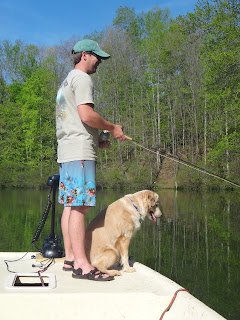
The weekend started with my first mate keeping watch over the lake Friday; on the lookout for the tell tale ripples left behind by fish enjoying the evening hatch.  While very adorable, she does pose a noise hazard, and makes it impossible to sneak up on any Grass Carp.  Luckily, the lake water looks to be clearing faster than anticipated.  Hopefully, this good stretch of weather will hold, and the clarity will continue to increase, allowing for better sight fishing opportunities.

Holding down the front of the boat, while waiting for the next fish
After playing host on Saturday to some friends from out of town, I was ready to get out and stretch the lines on Sunday.  What followed is some of the most active fishing I've ever experienced...anywhere.  Over the course of four hours, I boated some 100 fish, with 60-70 being crappie, and the rest a mix between bluegill and largemouth bass.  The crappie were found holding by two beaver dams, and reminded me of small tuna in the way they were aggressively pursing flies.  While I did snag a few on topwater, I quickly realized getting the fly down a foot or two resulted in a flurry of furious attacking...which prompted the small Clousers and damsel fly streamer patterns to come out.  Even though the crappie were in the 5-9 inch class, catching these on a two weight rod was more than satisfying...especially with the occasional largemouth bass to crash the party.  The trick was to keep the fly moving, even if only with subtle twitches.

This morning I decided to head up into the mountain blue lines, to cap my weekend off with breathtaking scenery, and a few brookies.  The fishing was a bit slower than expected, with less activity being found on the surface, although I was able to witness the occasional back flip as a trout lunged after my dry.  Overall, the better action was found below the surface, with the dropper being the hot item.  Personally, my favorite dropper to use is a lightning bug nymph, tied in most any color.  I believe as long as it has a bit of flash, the actual color of tinsel is not overly significant.  In addition to a few adult sized trout and creek chubs, I was able to have some fun with a few juveniles, and the good news is the future continues to look bright, as the fingerlings were happy and fat.

The juvenile brook trout were out in force, and appear to be very healthy
Hopefully, you were able to get out and enjoy this beautiful weekend as well...if not, well it is never to late to pick up a rod, and cast a line.

Monday, May 16, 2016

Rain and Travel

Well...this is awkward.  After all these days coupled with an unusual amount of rain (yes, just about everyone in the region broke their consecutive rain record), and an annoying packed work schedule, I do not have a fishing report to write.  Yes, I assume they are biting, but I have not had the pleasure of pursuing their hunger.

...hopefully, I'll have something next week.

Saturday, May 7, 2016

Fishing Report 7-MAY-2016

It's been a while since my last fishing report update, and there is good reason, other than laziness.  My goal was to have a clever update to include a photo of a flounder caught on the fly...sadly such a photo was not meant to be...nor any real report to speak of.

This past week, my Uncle and I went to Wachapreague, VA to target flounder.  The trip started off well enough, with three keepers pulled in off of conventional spinning tackle.  The goal was to help put enough fish in the ice box before pulling out the 8 weight to catch a seldom targeted fish on the fly.  Unfortunately, those three flounder were the only caught of the trip.  The already poor weather turned worse, and our trip was basically a wash out.  The goal is to return to the VA Eastern Shore in the summer, and take another crack at the flatties.

The three flounder of the trip...but they were all over 18"
To make up for the busted trip, I took advantage of being near my family's farm in Maryland, and took an hour to fish for stocked trout in the Patapsco.  Believe it or not, this trip saw my first rainbow on the fly (caught off of a PMX hopper imitation).  In retrospect, it's difficult to catch a rainbow when you only fish native brook trout waters :).  While not large or spectacular in any measurement, it is still another milestone in my fly fishing scrapbook.

Always love catching trout off of a dry.  This particular trout did a backflip out of the water to take the PMX,
I was hoping to end the week with a trip up to a blue line stream in the Shenandoah, now that the Rocky Mount fire is out, but a day wasted waiting on a FedEx package, and a surprise project to replace my mailbox post postponed my brookie adventure to next week.

Oh well, sometimes just getting out is reward enough in itself...and sometimes just being able to get out can be a daunting challenge.  The good news is the weather is clearing, and the warmer temperatures are returning...next week should be better :)

Thursday, April 28, 2016

Great Beginners Flies Series: Betts Grim Popper

Popper season is officially here, and with the Bass spawning in our local lakes and ponds, now is the perfect time to throw your favorite small popper for bluegill.  For me, I have special reverence for the Betts Grim Popper.
The Betts Grim Popper is the perfect beginners popper
I may be slightly biased towards this popper, since it was the first fly I caught fish with, and have always found it to be my go to "cheater" fly...for when I just want to catch something.  The key to this popper is its ease of use.  Because of the excellent profile, coloration, and design, this fly is just as effective sitting still as it is in motion.  This is all the better when you are learning how to cast.  While I was learning, many times I had a fish hitting this popper before I was able to begin a strip retrieve.

The other nice feature of this fly is its overall size to hook ratio.  What I mean by this is the hook is set far enough back to ensure most panfish worth catching can be hooked, but the shape of the body and legs helps prevent a small panfish from completely engulfing the fly (granted this can still happen, but I find it occurs a lot less with this fly).  After using several other types of poppers, this is a design feature I am grateful for, as I always strive to release the fish as quickly as possible...and remember to crush your barbs!

One thing to remember when fishing poppers, especially those with legs, the fly will have a tendency to spin, which can cause tangles, and lead to a higher frequency of wind knots.  Always check your leader and tippet after several casts, and never be afraid to retie.  In the end, tippet is always cheaper than poppers.

As for what you may catch...really anything that will take topwater flies will crush this little bug.  I have caught countless panfish, and quite a number of largemouth bass with this fly.  Fishing this fly close to rocks has lead to many good sized rock bass, and even the occasional crappie.  For the bass, short strips of the fly tend to lead to better takes.

Finally, no matter what you read, there is no wrong way to fish a fly, and no fly design that is wrong.  The real fun of fishing is to develop your own preferences and styles, and to find what works for you.  True, there are some purist who only use those patterns developed 100 years ago, but for me, if it catches a fish, I'll tie it on!

Monday, April 25, 2016

Fishing Report 25-APR-2016

The past week saw the largemouth bass in our area move into their spawning beds in our local lakes and ponds.  As a result, I decided to switch over towards targeting bluegills and other panfish.  This is actually where I started one year ago, when I threw my first fly, and always results in a good deal of fun on the water.  Every trip resulted in more fish than I cared to count, and small fish or not that is never a bad day :)

To celebrate my one year flyiversary (yes, that is now a word), I took a special VIP out for their first fishing trip, and she loved it!
Penny's first fishing trip was a blast!

In general, the panfish are hitting most anything they can, with smaller woolly buggers and damsel fly patterns being good streamers to cast from your favorite lightweight rig.  Personally, I love to throw a two weight TFO Finesse setup, which, in addition to my bluegill rod, doubles as my mountain brook trout rod.  This rod has a more classic action, which is great for beginners to really learn to feel when the line loads the rod.  It also helps when roll casting in the tight confines of a mountain stream, and for quick loading during shorter casts.  There is definitely an emphasis for faster and stiffer fly rods, but for beginners, nothing compares to a medium to slow action rod...plus they are way more fun to catch fish on!

As expected for this time of year, the fish are stacked against the shoreline, and are likely to be found near any fallen sticks or logs, and under the shade of trees and bushes.   If your local pond has any rock formations, this is a great time of year to target rock bass with a small zonker or other streamer.  These fish are really getting aggressive, and will often leave a wake as they zoom in to crush your fly.

While small, rock bass are a fun fish to catch off a lightweight fly rod, and a great way to learn how to fish streamers.

One of the best things about bluegill fishing is it is an easy, and fun, way to learn how to fly fish, especially when using a small popper or other floating bug.  With the water temps continuing to rise, the topwater bite is really starting to catch on, so now is a great time to learn!  Try using different techniques to entice a bite.  Often, just casting the fly next to some cover, and letting it sit perfectly still will result in a good splash, but sometimes adding a few short strips to twitch the popper will be needed.  If bass are around, using a pause-retrieve-pause pattern with strips of only a few inches can really be effective.  While I was not specifically targeting bass this week, I wasn't disappointed when more than a few decided to take my topwater poppers.  Even a small bass on a lightweight rod can result in a lot of fun!

No bass were eaten in the making of this post, but quite a few were licked :)

With the smaller bass already showing interest in topwater patterns, I cannot wait for the spawn to complete, and the topwater action to get really interesting.

Saturday, April 23, 2016

Great Beginner Flies Series: Zonker

Originally developed in the 1970's by Dan Byford, the zonker has become a mainstay in most any fly fisherman's fly box, with many variations to target most any species of fish.  This fly is so effective for two reasons:  (1) it is simple to tie, and (2) it yields unbelievable movement in the water.  This makes the fly attractive to the angler as well as the fish.

My personal favorite is using a striped bunny zonker strip with some flashabou added for a more reflective tail.  The key is to allow the flashabou to be slightly longer than the zonker strip.  So far, I have tied this pattern in green and white.  Almost every trip, one of these two zonker colors is on my four weight rod, ready to target largemouth, smallmouth, crappie, bluegill, rock bass, and most anything else that swims by.

I have found the most effective technique is to use slow to medium strips, with a pause and retrieve method often proving deadly when the fish are less aggressive.  Since the zonker tail has so much underwater movement, you will find the fly flutters seductively down the water column when pausing the retrieve.  If a slightly deeper presentation is desired, a conehead can be added.  Personally, I never tie the fly without a generous amount of wire wrapped around the hook shank, which helps to get the fly just below the surface.

The White Tiger Zonker, AKA the Siegfried and Roy

The Chartreuse Tiger Zonker
While the debate still goes on about whether adding a red throat yield better catch rates, I always prefer to tie with red thread, and to add a touch of red bucktail towards the front, simply to make the fly look better if nothing else.  Then again, I have caught a lot of fish with this pattern, so I feel the hotspot works.

As you can see, the zonkers above are a bit smaller than average.  I have found this smaller size to be more effective, especially if you are targeting bigger crappie and bluegill.  I have also caught more than enough bass to justify the smaller size, and, in general, have found smaller flies to be more effective.  In the end, feel free to experiment for yourself, and, as always, tight lines!

Saturday, April 16, 2016

Weekend Bliss in Maryland

Got to take the boat up to my old stomping grounds in Maryland this weekend, and had a fine day of catching crappie.  The second day was not as good, but saw the trip salvaged by a nice Maryland sized Northern Pike (aka, not that big compared to those monsters found up north).

It always strikes me how a hundred and fifty miles of northern latitude can affect fishing.  While the bass are nearing their spawning stage, and the topwater bite is already beginning in the lakes and rivers near Charlottesville, the Maryland waters are still too cold, with the fish down deep, and staging around the points on the outside of coves.

This weekend started with a Friday afternoon/evening trip up to Big Pool, near Ft. Frederick, MD.  There the water was more shallow, and therefore just warm enough for the crappie to really start getting active, and the slabs were stacked near the shoreline.  All in all we landed more than two dozen fish, and we took home a nice stringer  for my father and good friend to cook up.  While my friend and father were throwing traditional crankbaits, I did my damage with a clouser and waited zonker.  The fish were holding down deeper, and the trick was to get the fly near bottom.  Fishing would have been easier if I had a sinking or intermediate line.

A nice baker's dozen

Definitely a stringer worth a closeup

Day two involved a drive out to one of my favorite lakes, Triadelphia Reservoir.  Located north of our Nation's Capital, Triadelphia is a hidden gem containing both Stripped Bass and Northern Pike.  Due to the deeper depths, the reservoir was still quite cold, which made fishing much tougher.  All in all, we only pulled in two fish, but the second was a beautiful Maryland Northern Pike at ~30 inches (yes, up north they get much, much bigger, but this is what we have in the Mid Atlantic).  More importantly, it was my first pike on the fly!  Again, fishing deep was key, which made clousers essential.  This particular specimen found a chartreuse on white too irresistible to pass up.

My first Pike on the Fly!